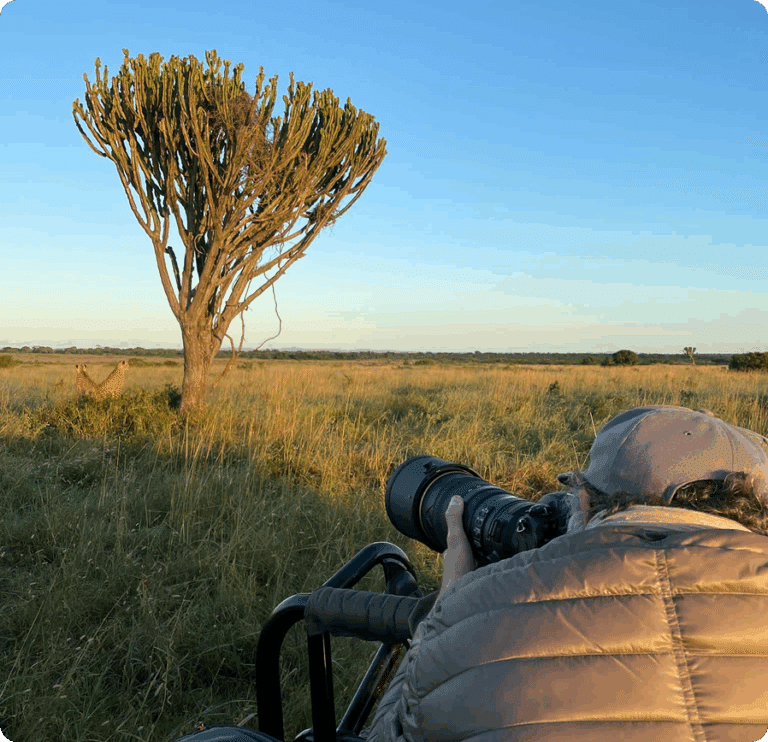
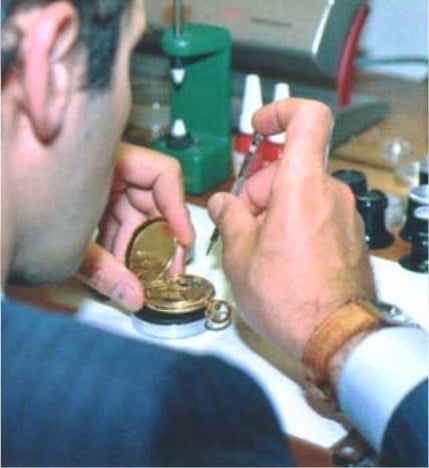
Starting your career as a watchmaker and developing a passion for wildlife photography may seem unexpected. However, the link between watchmaking and photography is more obvious than it seems. These two disciplines, which appear to be worlds apart, share the same requirement: mastery of the moment.
Photography and watchmaking: two arts of precision
At first glance, photography captures images while watchmaking measures time. One works with light, the other with mechanisms. Yet both pursue a common goal: to capture a precise moment and make it legible, almost tangible. Where the watchmaker fragments time into extremely precise gears, the photographer isolates a fragment to make it eternal.
Time as raw material
In both worlds, time is never an abstract concept. It becomes a working material in its own right. The watchmaker shapes the passage of seconds through balance wheels, escapements, and gears. The photographer composes with light and the moment, playing with shutter speed to freeze a movement or, conversely, suggest its continuity. A beat of the balance wheel is equivalent to a fraction of a second captured. The release of the shutter becomes a suspension of reality, a moment snatched from the flow of time.
Precision in every movement
When you take photographs with a watchmaker’s training, you accept that nothing can be left to chance. In the making of a photo, every setting and every adjustment counts. A tiny parameter can transform an image, just as a few microns can make the difference between an ordinary watch and an exceptional timepiece.
In both disciplines, precision is not immediately apparent, but it determines everything. Technical rigor is never an end in itself: it supports emotion, allows expression, and gives the final result its full power. This requirement imposes a form of patience, almost meditative, where the right movement takes precedence over speed. Neither watches nor photography tolerate approximation.
Aesthetics and mechanics: the beauty of the invisible
Fine watchmaking and photography share a deep fascination for what is not immediately apparent at first glance. Behind a sleek dial or a polished image lies a long and meticulous process involving successive trials, corrections, and adjustments.
What is striking about the collections is that beauty often arises from the invisible. The photographer reveals a watch mechanism in the same way that he reveals a face, an animal, or a landscape: through the play of light, the interpretation of textures, and the balance of contrasts. The final image does not show the effort, but it bears its traces. It is in this discretion that the elegance common to both worlds resides.
Transmission and heritage
A watch is passed down. So is a photograph. Both are objects of memory, charged with emotion and history. They tell a story of the past, bear witness to expertise, and are passed down through generations. In photography, this transmission takes on a special dimension through large-format prints, where every detail, every texture, and every nuance of light is permanently captured in time.
When presented in exhibitions, these images leave the intimate setting of the screen to become physical objects, meant to be seen, felt, and shared. Like a mechanical watch that is worn or passed on, an exhibited photograph is anchored in reality, inscribed in time and engages in dialogue with those who contemplate it. In this digital and instantaneous age, prints and exhibitions embody a form of resistance: that of the long term, of work well done and of sustainability.
The mastered moment
Ultimately, photography and watchmaking pursue the same ideal: to tame time without ever stopping it. One measures it to better honor it, the other captures it to better feel it. Between the ticking of a mechanical movement and the clicking of a shutter, there is one essential commonality: absolute respect for the moment.