News

Leopard versus Cheetah

Partager l'article

19 March 2026
Guépard prend la pause

Two iconic felines of the savannah

Over the course of my many safaris in Africa, I quickly understood that a solid knowledge of wildlife and flora is essential for anyone wishing to practice wildlife photography. Photographing wildlife is not just about pressing the shutter at the right moment. Above all, it is a matter of observation, patience, and respect. Respect for the animals’ territory, respect for their natural behavior, and respect for the rhythm of nature.

The savannah is a living, unpredictable, and fascinating world. Every outing brings its share of surprises. Some days are spent in silent انتظار for a movement in the tall grass, while others offer scenes of extraordinary intensity.

Among all the animals I have had the chance to observe, big cats hold a special place in my heart. Their elegance, power, and discretion make them fascinating photographic subjects. Perhaps also because they awaken a childhood memory — that of the stuffed animals we once held in our arms. But when facing them in the wild, there is nothing toy-like about them: only the raw, untamed beauty of a predator perfectly adapted to its environment.

With every encounter with a feline in the savannah, the emotion remains intact. Even after many safaris, the moment still retains something magical.

During my photographic exhibitions, I often notice that many visitors confuse two iconic species of the African savannah: the leopard and the cheetah. This confusion is common, as both have spotted coats and belong to the large feline family. Yet they are very different, both in their morphology and their behavior.

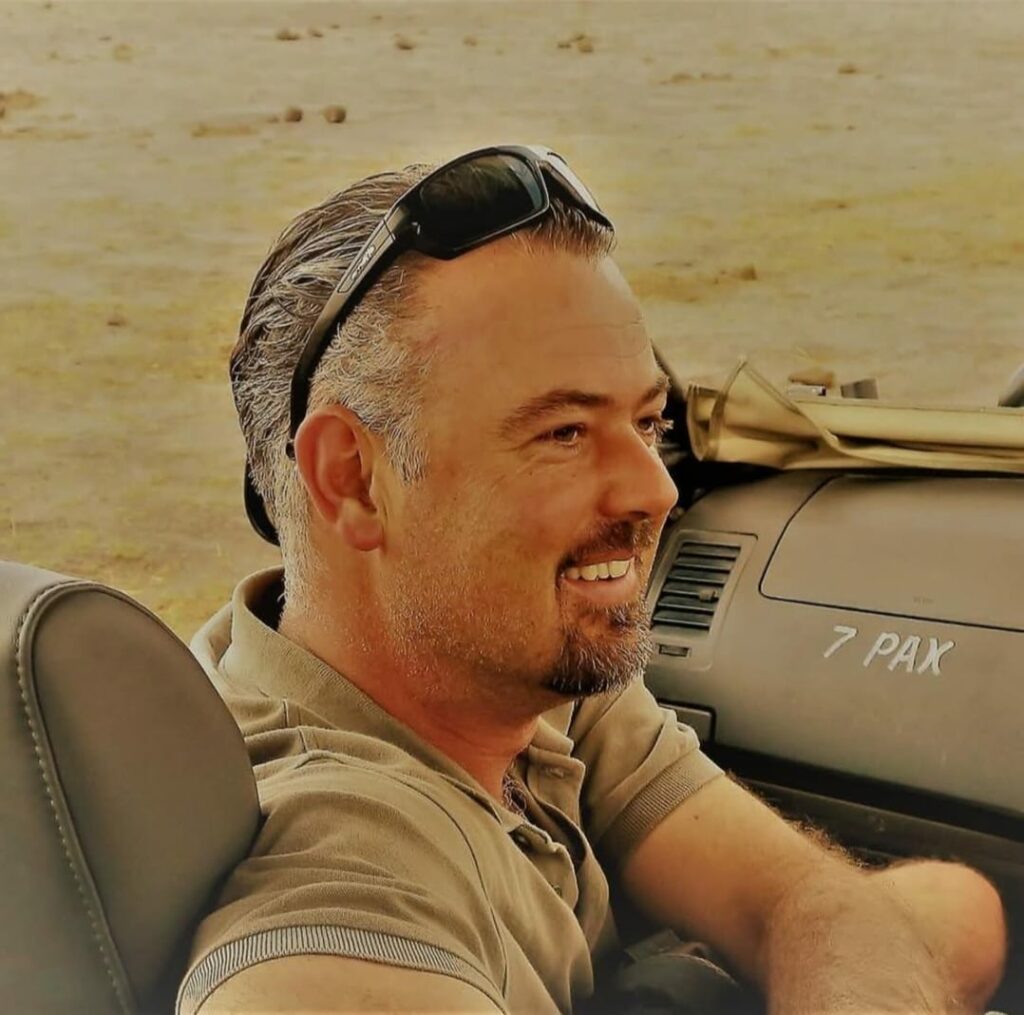
Over the years, my guide Mike, with whom I regularly explore the savannah, has taught me a great deal about these extraordinary animals. Thanks to his experience and keen eye, I have learned to observe the details that distinguish these two predators, as well as to understand their habits and hunting strategies.

Taking the time to focus on the particularities of these two species not only helps avoid confusion but also allows one to fully appreciate the richness and diversity of the wild.

The Cheetah: Speed in Its Purest Form

Guépard prend la pause

The cheetah is known as the fastest land animal in the world. During a chase, it can reach an impressive speed of 110 to 120 km/h (68 to 75 mph). This explosive sprint lasts only a few seconds, but it is usually enough to catch prey taken by surprise.

Its entire anatomy is built for speed. Its body is long, slender, and extremely lean. Its highly flexible spine acts like a spring, allowing it to extend its stride and increase its speed in record time.

Its long tail also plays a crucial role. It acts as a counterbalance, helping it maintain stability and make rapid directional changes during a chase.

A lesser-known detail concerns its claws. Unlike most felines, a cheetah’s claws are not fully retractable. They remain slightly extended, providing better traction on the ground, much like the spikes of a sprinter.

The cheetah’s face also has a very distinctive feature: two black lines under the eyes, called “tear marks,” which run down to the mouth. These natural markings help reduce sun glare and improve vision during hunting.

Unlike many other felines, the cheetah primarily hunts during the day. It favors open spaces where it can fully exploit its exceptional speed.

The Leopard: Power and Stealth

Portrait léopard

The leopard has a very different silhouette. More compact, more muscular, and much more powerful, it is one of the most adaptable predators of the savannah.

Its impressive strength allows it to drag prey sometimes heavier than itself up into trees. This behavior helps protect its meal from other predators such as lions or hyenas.

The leopard is also a master of camouflage. Its coat is made up of rosette-shaped spots — black circles surrounding a lighter center. This pattern allows it to blend perfectly into vegetation and shifting light and shadow.

The cheetah, on the other hand, has solid black round spots distributed across its body. This difference in coat pattern is one of the easiest ways to distinguish between the two species.

Maman léopard et son petit
maman guépard et ses petits

The leopard is a much more discreet and solitary animal. It mainly hunts at night, taking advantage of darkness to ambush its prey. Its adaptability allows it to live in a wide variety of environments: savannahs, forests, mountainous regions, and sometimes even near human settlements.

Photographing Wildlife

The images you discover in my collectionsPortrait and Family — are the result of many hours of observation in the field.

Wildlife photography requires patience. Sometimes an entire day passes waiting for a fleeting appearance in the savannah grass. At other times, everything happens in just a few seconds.

These felines remain difficult animals to spot and approach. One must pay attention to the slightest clues: a track in the dust, movement in the bushes, the silent alert of a group of antelopes.

Being in the right place at the right time involves some luck, but above all, it is experience and observation that make it possible to capture these unique moments.

Each photograph represents a singular encounter with the wild. My goal is to share these rare moments and offer a more intimate perspective on these magnificent animals, in order to better understand their beauty, their strength, and the fragility of their environment.

Partager l'article

Les dernieres news

Guépard prend la pause

Leopard versus Cheetah

photo portrait Mike Karantonis, guide de terrain

Mike Karantonis, field guide, 30 years in the heart of the African savannah

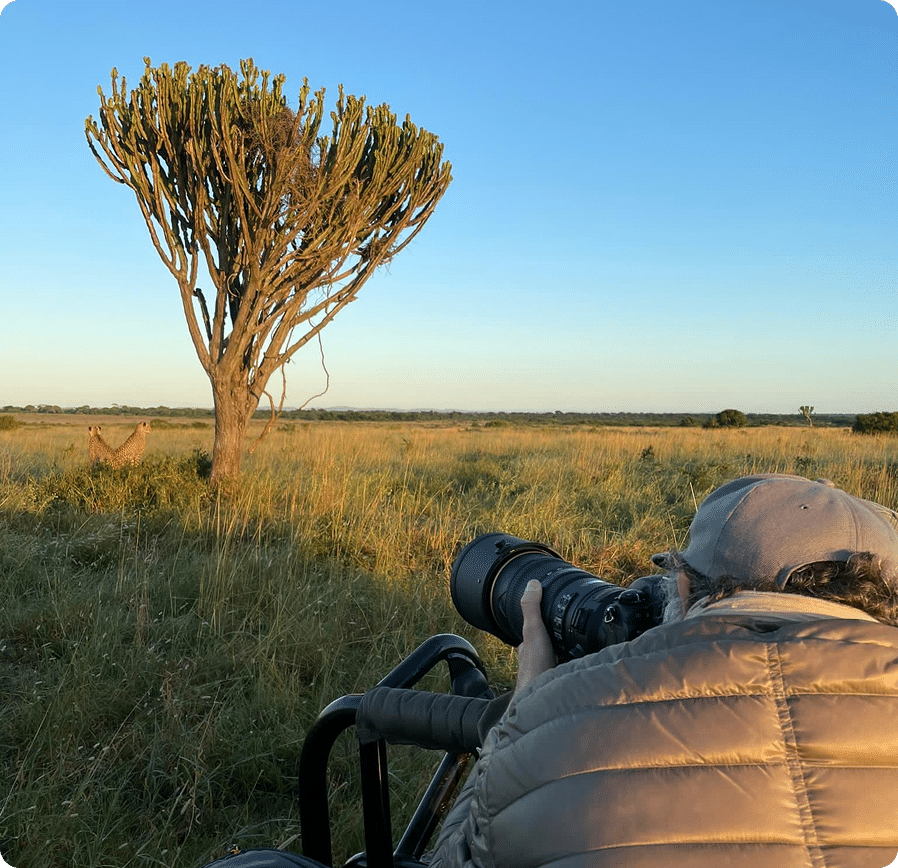
Denis Asch taking pictures of 'WILD HEART'

A watchmaker who takes wildlife photographs?