The true beauty of a safari lies in this humility, accepting that we are merely visitors in a world that does not need us.
Equipment
Wildlife photography requires patience, perseverance and sharpness. The guides teach us a great deal about this wild and demanding natural environment, inspiring us with a deep respect for the flora and fauna.
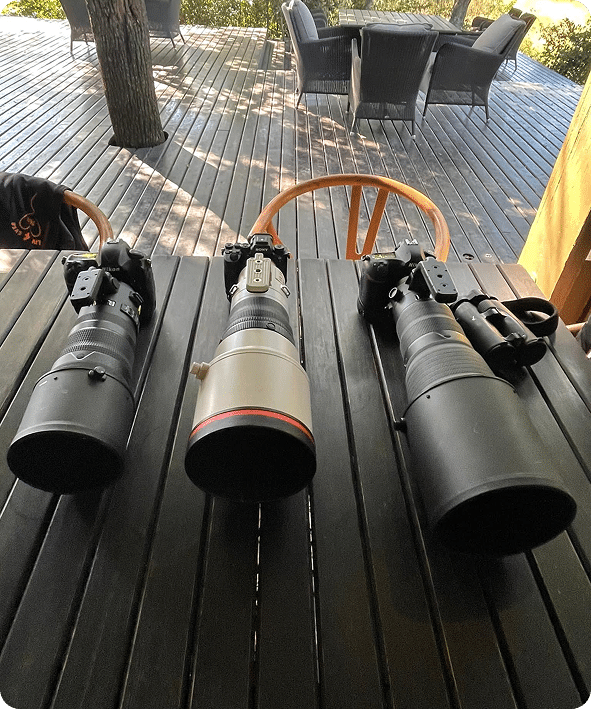
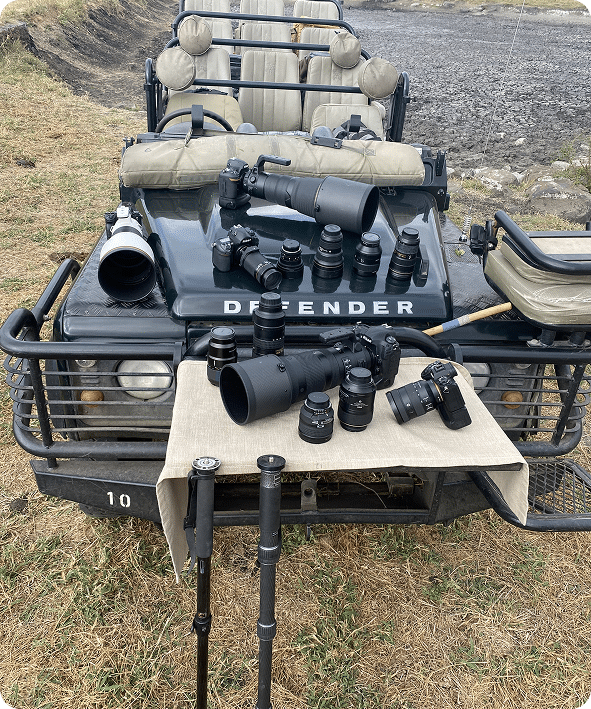
Animals in the bush do not pose, and in most cases, they only give us a very short amount of time. You have to be very responsive. In order to waste as little time as possible, I equip myself with several lenses and at least two cameras, so that the right camera with the right lens is always at hand.
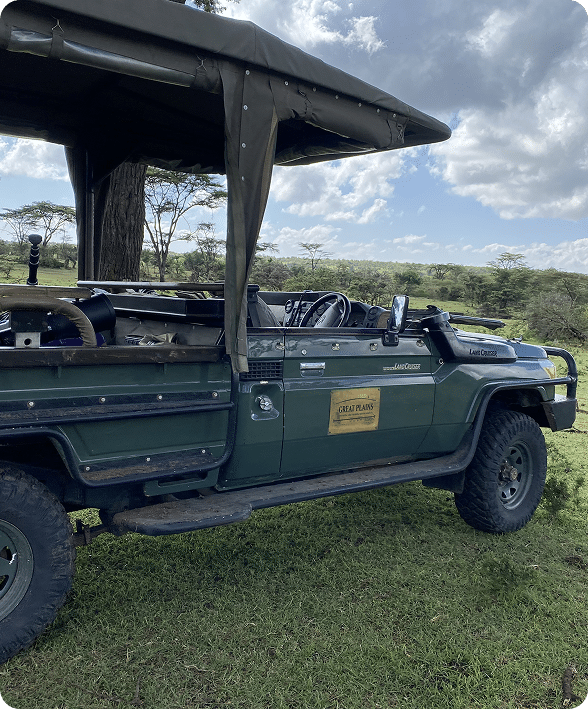
The vehicle we are travelling in must always stop at a sufficient distance to respect their space and territory. The photographer must always be able to adapt to any situation. Some species may be more or less aggressive depending on the situation, whether they are feeding, hunting or with their young. The first rule that the guide repeats is: ‘WE ARE IN THEIR HOME!’
In order to be versatile and as responsive as possible, your equipment must be sufficiently extensive:
Wide-angle lenses for landscape photos or scenes requiring wide shots (15-24 mm, 24-70 mm, etc.)
Lenses for portraits or close-up scenes (85 mm, 105 mm macro, etc.)
Various telephoto lenses (80-200 mm, 120-300 mm, etc.) for distant scenes.
Super telephoto lenses, such as 400 mm (some with built-in extender 400 x 1.4 = 520 mm), 600 mm, 300-800 mm
Certain camera bodies or lenses will be more or less suitable depending on the desired scenes. Photos of birds or fast-moving animals (cheetahs running, for example) require lenses with ultra-fast autofocus, a large aperture, high brightness and preferably light weight for better tracking without blurring.
Some camera bodies or lenses will be more or less suitable depending on the desired scenes.
In order to be versatile and as responsive as possible, the equipment must be sufficiently extensive.
The car we are in must always stop at a sufficient distance to respect their space.
Today’s devices allow us to take high-quality photos in difficult lighting conditions and also feature increasingly sophisticated systems that compensate for vibrations that could affect the final sharpness of the photo.
Today’s processors are increasingly efficient and fast for digital cameras. Each photo is captured in very high definition and therefore requires sufficient memory with a fast processor so that each photo is perfectly recorded without interfering with the next shot. For example, burst shots of birds in flight.
The electronics in today’s cameras are evolving very quickly, with improvements in contrast management, low-light performance, image processing speed and autofocus. This is a great help, as African wildlife is unpredictable and the light is not always easy to control.
A team
The guidance of a good guide teaches us to better understand this vast and complex wildlife, allowing us to anticipate the movements and reactions of each animal. We must remain vigilant at all times in order to be as responsive as possible.
The guide with whom I have been exploring the savannah for many years, along so many different trails, knows everything about the local flora and fauna. He can adapt to each animal, depending on its behaviour and the situation. He knows all these paths like the back of his hand, and even better. The nature reserves we explore are immense.
For example, the South African reserve ‘Sabi Sands’, known for its leopards, covers an area of 650 km². It is medium-sized, more than six times the size of Paris. Kruger National Park is South Africa’s best-known nature reserve, covering an area of approximately half the size of Switzerland: 19,500 km².
In the bush, very few animals are truly dangerous; they only attack if they feel that their offspring or food is threatened. It is only by respecting their environment and keeping a certain distance that we can photograph them. For generations, they have known that cars carrying tourists do not pose a threat. They ignore us.
Thanks to valuable clues, the guide does everything possible to find an animal. Each animal has a specific call, footprints and droppings. In addition, some species of birds and monkeys help each other by communicating danger through calls and songs. Each species also has a different rhythm of life, hunting and resting.
Behind the scene
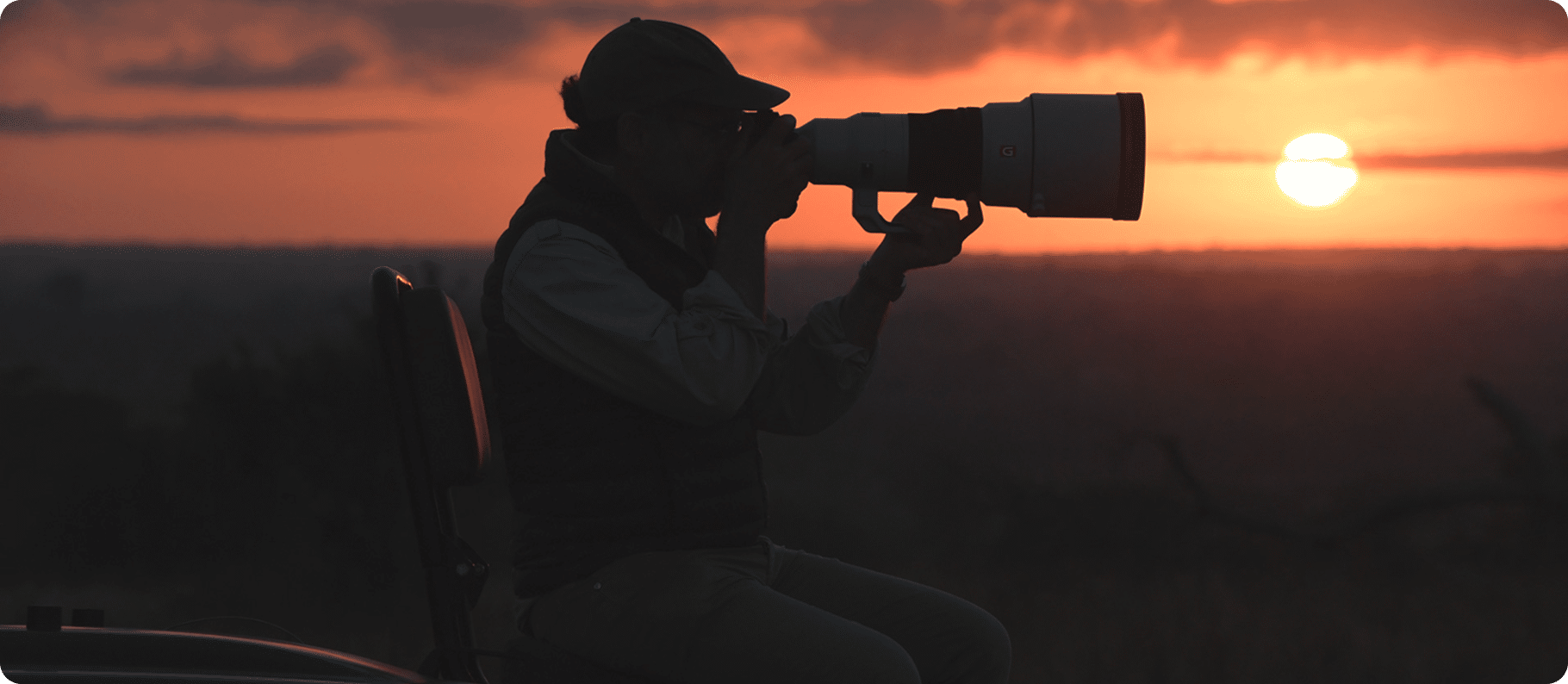
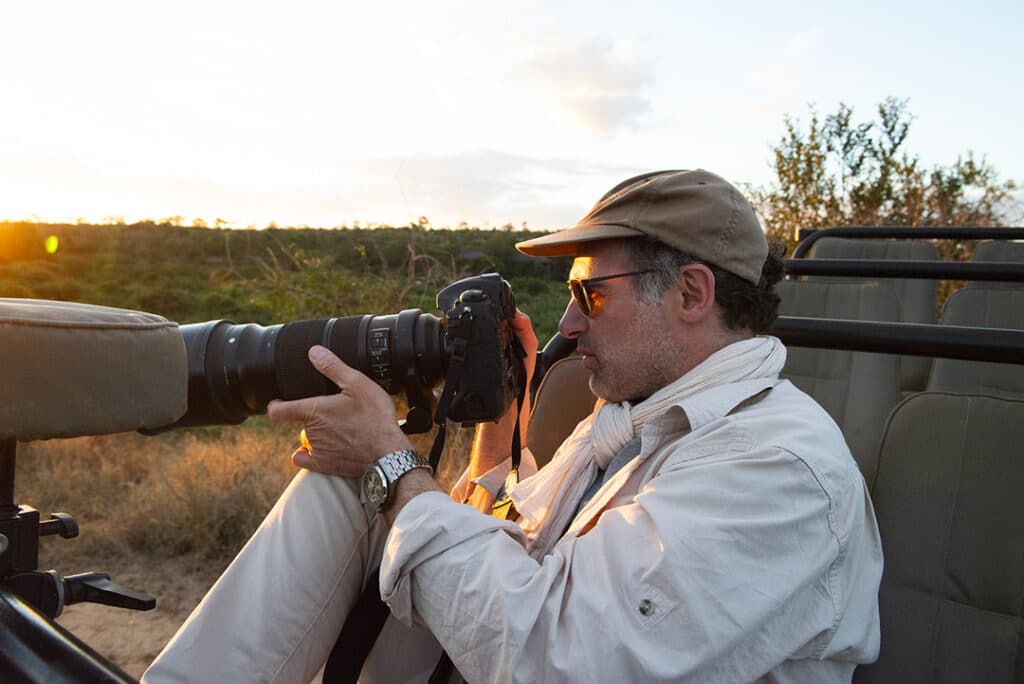
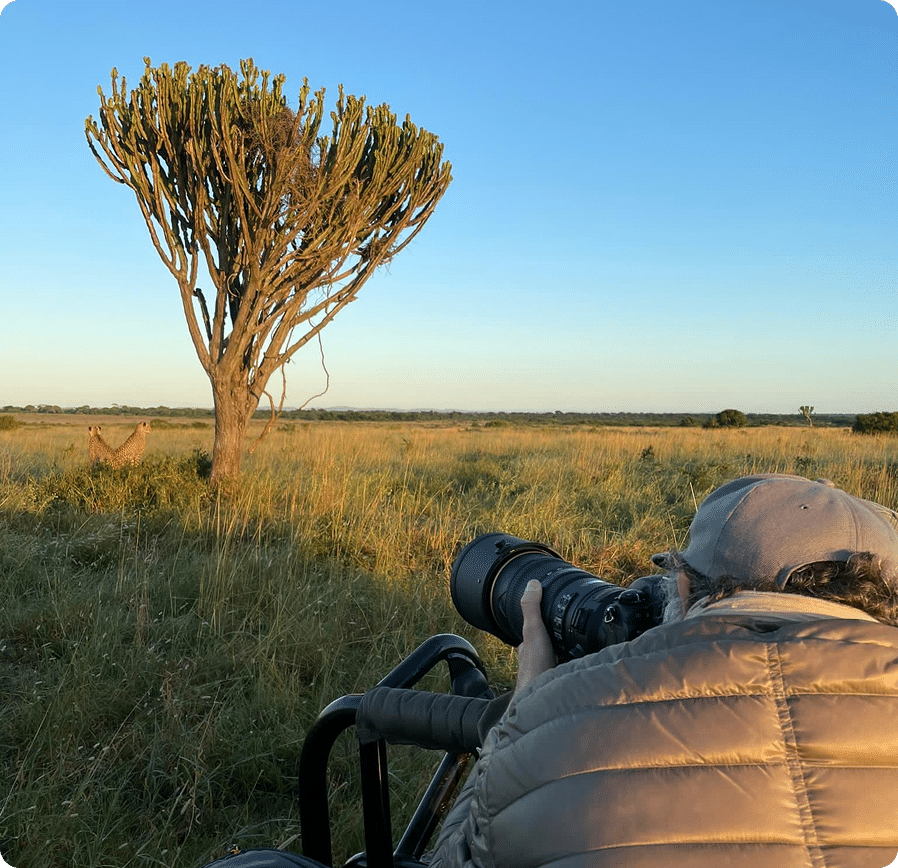
Denis Asch taking pictures of ‘WILD HEART’
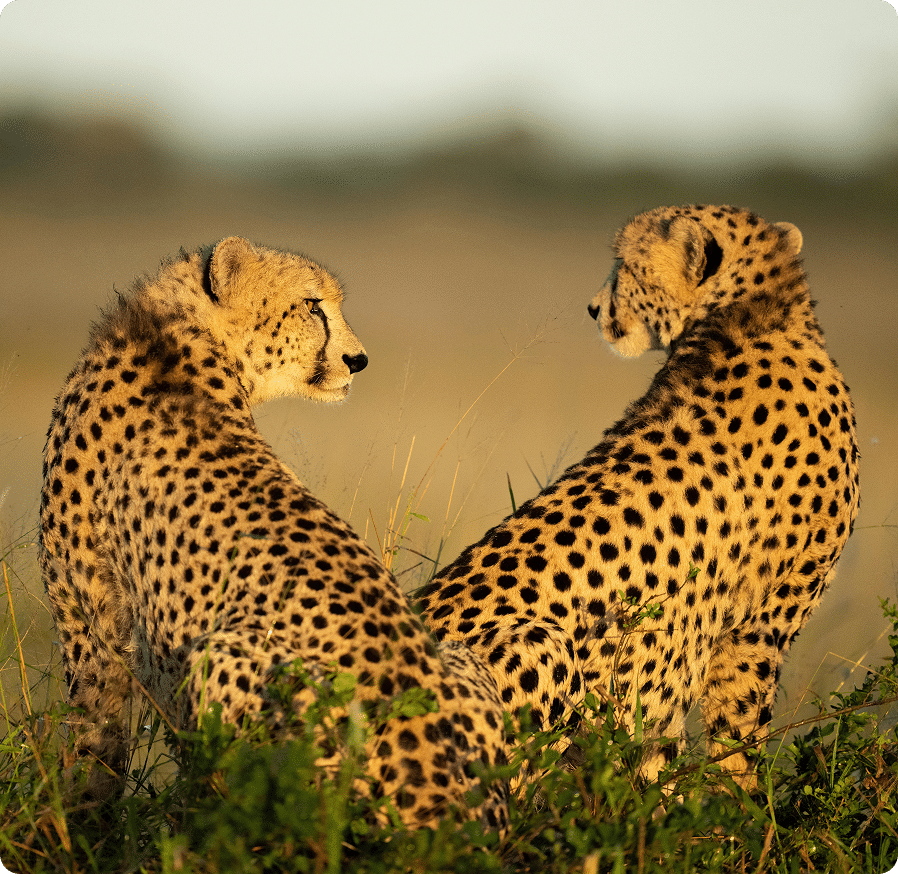
WILD HEART, Phinda Game Reserve, South Africa
‘06:38’, The day has just dawned, it’s the best time to take a photo with unrivalled light quality. At this time of day, the sun offers magnificent orange colours, it is still very low on the horizon and does not cast shadows on the animal’s face. The coats of many bush mammals are beautifully adapted to their environment, serving as camouflage. The cheetah’s body is built for running, with a slender, aerodynamic physique and lungs adapted for greater endurance. Cheetahs are distinguished by the black stripe running from their eyes, which reduces harmful reflections from the sun.